


Russia-Ukraine: is it worth turning the world in the opposite direction?



Ukraine’s victory in the war with Russia is strategically beneficial to the Arab states of the Middle East, as it destroys the Kremlin’s imperial ambitions and stabilizes the global security architecture
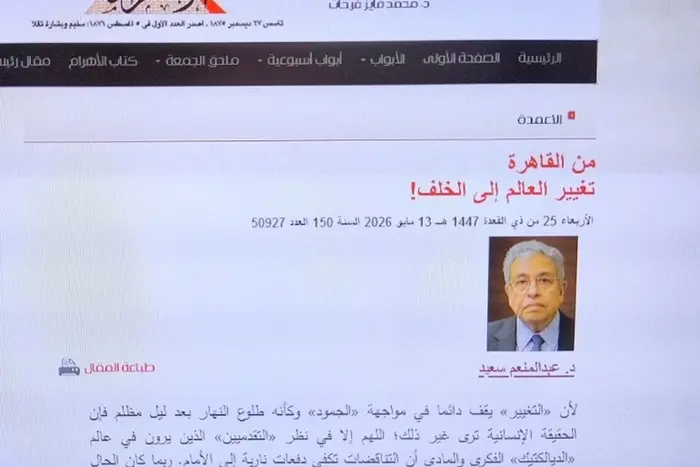
Although the Arab world tries to maintain a neutral position regarding Russia’s war in Ukraine, sometimes the attitude of intellectuals towards the Russian-Ukrainian war slips into the press. For example, the influential Egyptian newspaper Al-Ahram published an article by Dr. Abdul-Moneim Said, «Turning the World in the Other Direction!» An article worth paying attention to.
In it, the authoritative Egyptian strategy expert Abdul-Moneim Said, who is the director of the Regional Center for Strategic Studies – Cairo and a senior fellow at the Crown Center for Middle East Studies at Brandeis University, in particular, notes: «Change» is the natural opposite of «stagnation», like dawn replacing a dark night. «Progressives» believe that in the world of intellectual and material «dialectic», contradictions are enough to move us forward. Maybe so, and maybe not. But the reality is that even in moments of “regressive change” for the worse, we still have to deal with this situation.
The third decade of the 21st century began with the Covid-19 pandemic. Despite significant advances in medicine, humanity found itself in a state of confusion and was forced to rebuild its life, because no one knew how the spark of the «pandemic» was ignited.
From the depths of this disaster arose the Ukrainian war, which was followed by the fifth war in Gaza and its consequences, and then the fourth war in the Persian Gulf and its consequences.
After these events, humanity lives in realities where history has regressed and is no longer moving forward.
Proof of this is the Russian invasion of Ukraine after the collapse of the Soviet Union, followed by the displacement of Palestinians, as well as the attack on Iran, the latter’s reaction to the aggression being directed not against the aggressors, but against those who are spending energy on preventing war: the Arab states of the Persian Gulf.
All of these events led to the collapse of the UN Charter and international humanitarian law. The woes of the planet, the erosion of the influence of all multilateral international organizations and the deterioration of natural conditions caused by global warming are shaking humanity.
The above fragment of an article by Dr. Abdul-Moneim Said in the influential Egyptian publication Al-Ahram is an example of the transformation of political thought in the Arab world regarding global conflicts. It is clear that the author could not ignore the traditionally ritualistic topic of «Palestinians» for the Arab world, weaving it into the context of the Russian-Ukrainian confrontation.
But, as an experienced analyst, Dr. Said goes beyond the official diplomatic neutrality of Cairo and offers a profound conceptualization of modern international security.
His assessment of the Russian invasion of Ukraine is not simply a statement of fact, but a fundamental condemnation of the destruction of the world order, which he interprets as a historical regression.
And here the key element of the author’s analysis is the destruction of the linear concept of progress. Abdul-Moneim Said uses the philosophical category of «dialectic of contradictions» to demonstrate that the development of humanity is not a guaranteed movement forward.
Instead of the expected «dawn» after the end of the Cold War and the collapse of the Soviet Union, the world has found itself at the point of a cyclical rollback to the worst practices of the past.
The intellectual calls the Russian invasion of Ukraine the first and main evidence of this regression. It is characteristic that the Egyptian scholar clearly defines Russia’s actions as an «invasion» (i.e. aggression), completely ignoring the Kremlin’s propaganda narratives about «denazification» or «forced self-defense».
For the Arab intellectual community, which is often influenced by Russian propaganda, such a direct formulation in the leading state media of Egypt is symptomatic. It indicates that at the level of political expertise there is a full understanding of the imperialist and revisionist nature of Moscow’s actions.
Of particular interest is the causal chain that Abdul-Moneim Said builds. He connects the Covid-19 pandemic, the war in Ukraine, the escalation in Gaza and the conflict around Iran into a single system of global destabilization. The author demonstrates how the destruction of the system of international law in one point of the planet – in Ukraine – inevitably triggers a domino effect that destabilizes the Middle East.
For the Egyptian audience, this connection is critically important. Dr. Said explains to readers that Russian aggression against Ukraine is not a distant European conflict, but a negative geopolitical push that has enabled further chaos in international politics and a direct threat to security in the Persian Gulf.
The mention of the «fourth Gulf war» and the inadequate response of Iran, which directs its aggression at moderate Arab monarchies instead of real opponents, emphasizes the author’s deep concern for regional security.
It can be said that the publication indicates a hidden split between the official pragmatism of Arab capitals and the real strategic vision of their elites. Publicly, Egypt and other countries in the region are forced to balance due to a certain dependence on Russian grain imports, tourism, and military-technical cooperation.
However, Dr. Said’s analysis exposes the deep fear of Arab elites of a world where the right of force replaces the power of law. If a great power can invade a sovereign neighbor with impunity after the collapse of a former empire, then any medium or small country in the Middle East finds itself under the threat of a similar «border review» by regional hegemons.
The article in Al-Ahram shows that in expert circles in the Middle East, the Russian-Ukrainian war is perceived not as a local dispute, but as a catastrophic violation of the global rules of the game, pushing humanity into the darkest times of geopolitical regression.
At the same time, Dr. Said’s argument in Al-Ahram clearly demonstrates the tectonic shifts in the perception of global security by non-Western intellectual elites. The author accurately captures the main security reality of our time, where the Russian-Ukrainian war is not a local border clash, but a precedent-breaking destroyer of the Westphalian system and the UN Charter.
For the countries of the Middle East, whose borders historically have an artificial colonial character and are often contested by neighboring states, the degradation of international law to the «law of force» poses a direct existential threat.
When the Russian Federation, as a nuclear power and a permanent member of the UN Security Council, legitimizes revisionism on the basis of an imperial desire for revenge, it automatically creates a precedent of impunity for aggression for regional hegemons around the world.
Middle Eastern small and medium-sized states, deprived of reliable «nuclear umbrellas» or strict alliance commitments like NATO, acutely feel their own vulnerability to potential border revisions by stronger neighbors.
Therefore, the projection of the Ukrainian experience onto the realities of the Middle East forces local experts to realize that the destruction of the principle of territorial integrity in Europe will inevitably destabilize their own region, provoking a new wave of militarization, secret nuclear programs, and preventive conflicts.
Abdul-Moneim Said’s analysis destroys the widespread myth that the Global South perceives the war in Ukraine exclusively through the prism of anti-Western sentiments or blind support for Russia. On the contrary, there is a sober, pragmatic, and even selfish security calculation here: if the world order finally regresses to an anarchic state of «war of all against all», then no diplomatic guarantees or historical treaties will protect the sovereignty of weaker actors from geopolitical absorption.
This article in Al-Ahram is a key indicator that Arab academic thought clearly links the end of the Russian-Ukrainian war to the future architecture of its own regional security.
And the main conclusion is that the helplessness of international institutions in the face of unprovoked aggression is triggering an avalanche-like process of deglobalization and geopolitical regression, where military superiority becomes the only guarantee of survival.
For the Middle East, this means the inevitable approach of an era of harsh military realism. When the failure of the world community to protect international law in Ukraine effectively unties the hands of local expansionists like Iran and condemns small states to a constant expectation of a catastrophic revision of their sovereign borders.
Influential Egyptian intellectual Dr. Abdul-Moneim Said indirectly draws a logical conclusion: Ukraine’s victory in the war with Russia is strategically beneficial to the Arab states of the Middle East, as it destroys the Kremlin’s imperial ambitions and stabilizes the global security architecture.
First, Moscow’s defeat will sharply weaken its key military-political ally in the region – Iran. Deprived of Russian technology, diplomatic cover at the UN and financial infusions from arms sales, Tehran’s «axis of resistance» will lose the ability to effectively finance its proxy groups in Yemen, Lebanon, Syria and Iraq. This will allow the Sunni monarchies of the Gulf, in particular Saudi Arabia and the UAE, to strengthen their own regional leadership position and reduce the level of a permanent security threat.
Second, the full restoration of Ukraine’s sovereignty will return predictability to world food and energy markets. For countries like Egypt, which is critically dependent on Black Sea grain imports, a prolonged war means constant risks of famine, high inflation, and social instability. And a stable Ukraine guarantees Cairo’s food security without political blackmail from the Russian Federation. In addition, the long-term ouster of Russia from the European energy market will finally consolidate the status of Middle Eastern oil and gas exporters as indispensable strategic partners of the West.
Third, Ukraine’s success will demonstrate the inviolability of the principle of territorial integrity and international law. And the Middle East has historically suffered from external interventions and border disputes.
Thus: the defeat of the aggressor – Russia – will prove that changing borders by force is unacceptable in the 21st century, which will protect the weaker states of the Middle East region from the expansionist intentions of their stronger neighbors and lay the foundation for long-term regional peace.








Коментарі — 0