


Moscow propagandists are harbingers of Russia's future defeat



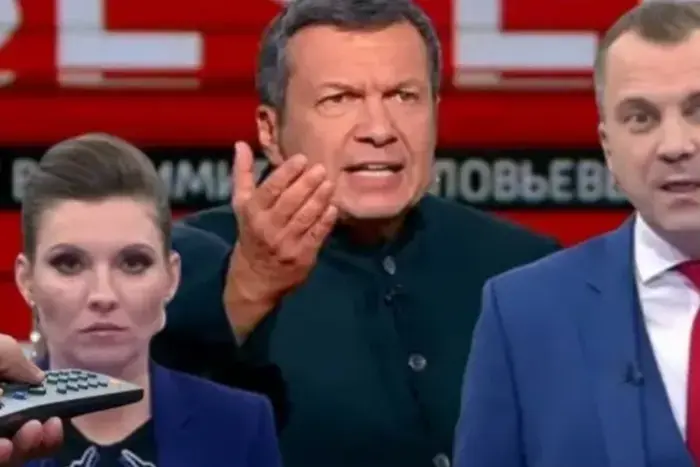
The information dome cannot hide reality forever: economic exhaustion, military failures, and internal divisions are becoming obvious even to the most blinded Russians. Propaganda continued the survival of Putin’s dictatorial regime. But not for long
The role of the Russian propaganda machine in the survival and continued functioning of Putin’s dictatorial regime clearly goes far beyond the usual information support of state policy, turning into a fundamental pillar of totalitarianism and a key tool of social engineering.
And here it is worth noting that in the modern Russian Federation, the mediaocracy has become not just a relay of the Kremlin’s will, but an autonomous ecosystem that ensures the legitimization of criminal power through the total construction of a parallel political reality.
This further primitivizes the already simplified thinking and perception of the world of the population of Muscovy. Using a complex combination of Soviet mobilization practices and postmodern manipulation techniques, Kremlin propagandists have successfully transformed the social contract, replacing economic well-being with the ideology of a «besieged fortress» and messianic revanchism.
This allows Putin’s regime not only to eliminate internal contradictions and marginalize any opposition, but also to maintain a high level of public apathy or aggressive loyalty even in conditions of protracted military conflicts and international isolation.
In Russia, the activities of media functionaries have become a strategic resource for the survival of the dictatorship, where control over the meanings and emotions of the masses is no less important than the power apparatus or raw material rent.
The role of Russian propagandists in supporting and continuing the functioning of Putin’s regime is a complex and multi-level phenomenon that combines media manipulation, ideological consolidation, and strategic disinformation at both the domestic and external levels.
After all, Russian propaganda acts not only as a tool for shaping public opinion, but also as a mechanism for legitimizing the actions of the state apparatus, which constantly violates international norms and human rights. It shapes perceptions of external threats, creating an «image of the enemy» that justifies the concentration of power in the hands of the Kremlin’s political center, the destruction of freedom of speech, political competition, and civic activism.
Propaganda media and state communication platforms systematically broadcast narratives that reduce the social distance between the government and the population, creating a sense of «national unity» and joint protection from external and internal enemies. At the same time, ignoring or discrediting any alternative points of view.
At the domestic level, Russian propagandists use a wide range of techniques: from filtering information, biased coverage of events, manipulation of facts to outright lies. And this allows citizens to form a stable perception of the state’s aggressive policy as necessary and inevitable.
Through repeated messages and information campaigns, repressive practices are «normalized» such as the persecution of opposition leaders, the elimination of press freedom, control over the educational sphere, or the shutdown of the Internet.
At the same time, Russian propaganda is not limited to classic media: it integrates social networks, the blogosphere, and numerous online platforms. This allows for the rapid dissemination of agreed narratives and the prompt response to crisis situations, thus minimizing potential political instability.
And the goal of propaganda is not only to justify the crimes of Putin and his entourage, but also to completely exclude the population from political life by suppressing their initiative and critical perception of reality. Thereby forming civil passivity and reducing the level of critical thinking about the actions of the authorities.
At the external level, Russian propagandists play the role of a means of geopolitical influence aimed at legitimizing the Kremlin’s policy in the world and expanding the sphere of information control.
International media resources, such as TV channels and online platforms, coordinately promote the image of Russia as a «victim of global conspiracies» and «unfair sanctions», which allows justifying any aggressive foreign policy actions, including a military invasion of Ukraine.
This narrative is often integrated into the local contexts of other states, fueling populist and anti-Western sentiments, which complicates international coordination to counter Russia’s totalitarianism and end its war in Ukraine.
In such an environment, propaganda becomes an instrument not only of internal stabilization, but also of foreign policy strategic flexibility, providing the Putin regime with the opportunity to continue its activities in the global political space with a certain level of immunity from international pressure.
It is important to note that the effectiveness of propaganda campaigns is largely based on socio-cultural factors, including historically formed stereotypes, collective memory and psychological mechanisms of information perception.
Here, Russian propagandists skillfully exploit chauvinistic imperial sentiments, fears and misunderstanding of global processes. In such an environment, any alternative facts are automatically rejected or perceived as unreliable. As a result, the residents of Muscovy cease to believe the truth, considering independent sources hostile, and independent speech as dangerous manipulation.
In this way, propaganda supports Putin’s regime and systematically forms among the population a willingness to make political decisions that meet the interests of the authorities, often contrary to the personal economic or social interests of the inhabitants of Russia.
Therefore, the role of Russian propagandists goes far beyond simple information: it becomes a key element of the political mechanism for supporting the totalitarian regime, combining legitimation, control and strategic influence both within the country and in the international arena. This ensures the stability and duration of Putin’s power even in conditions of economic crises, social tensions and international isolation.
Currently, the Russian propaganda machine is not just a tool for media support. It is a fundamental architectural support of Putin’s neo-totalitarianism, which performs the function of «worldview firmware» of the entire state organism.
In the conditions of the systemic decline of democratic institutions, it is propaganda that has taken on the role of the main integrator of society, replacing the real social contract with an artificially constructed consensus around the ideas of siege, messianism and existential threat.
Analyzing this mechanism, it is worth noting that it works not to convince a rational subject, but to completely atrophy critical thinking and create an alternative normativity, where war becomes peace, and isolation becomes sovereignty.
This allows the Putin regime to effectively channel social discontent, turning internal economic degradation into fuel for a «holy struggle» against external «enemies», thereby removing responsibility for the well-being of citizens from the government.
State propaganda has become an effective safeguard against resistance, demonstrations, riots, riots, or uprisings. It portrays the opposition as the greatest «evil», teaching people to think that any alternative to Putin is a catastrophe, the terrible consequences of which they cannot even imagine. Forming in society a persistent psychological aversion to the very possibility of another political course.
In the international arena, the propaganda apparatus acts as a weapon of asymmetric warfare. It is aimed at the erosion of the values of liberal democracy, the destabilization of Western alliances and the legitimization of the right of force over the power of law, which turns an aggressive totalitarian regime into a global exporter of chaos.
The survival of the Putin system is directly proportional to the effectiveness of its media coverage, because at the moment when the propaganda noise ceases to cover up reality, the Putin regime will face a void of its own illegitimacy, which no power resource can fill.
This makes propagandists not just accomplices, but also critically important nodes of control. Without them, the political construction of the modern Russian Federation would lose its structural integrity under the pressure of the first large-scale socio-economic turbulence.
When the moment of truth comes, Russians will understand that being loyal no longer makes sense, and the elites will realize: the «magic» of the leader has disappeared along with the television image on which everything was based. The fictitiousness of the leader’s «charisma» will become obvious, because it has been artificially created by media means for decades.
The critical vulnerability of this construction lies in the fact that the power resource, despite its scale, is secondary in the modern Russian context. Without an ideological foundation, this power will instantly devalue and become demoralized.
The special services and the army are able to suppress point protests, but they are powerless against total delegitimization if the security forces stop believing in the «truth» they defend.
Therefore, propagandists are not only the «voices» of the regime, but its program code, which preserves the logic and unity of the system in the conditions of a deficit of its real achievements and victories.
Any large-scale socio-economic turbulence that the media machine cannot handle will inevitably lead to the collapse of Russia’s structural integrity not under the pressure of external forces, but due to an internal vacuum of meaning. Because without virtual support, Putin’s system will turn out to be just an outdated administrative form, devoid of internal content and historical perspective.
Today, Russia is very similar to the late Soviet system of the 1980s, but with a much weaker ideological foundation. Unlike the USSR with its Leninist dogma, modern Russia is based only on the cult of force. After all, the artificial «Russian world» has never been able to become a full-fledged replacement for communist ideology.
As soon as the power of the regime turns out to be powerless and the propaganda media are completely discredited, this construction will collapse under its own weight. Because at its center there is nothing but the usurper Putin, whose rule cannot be eternal.
And here opens a unique window of opportunity for the defection of key figures of Russian propaganda: Skabeeva, Solovyov, Popov or Simonyan. Their transition to the West and public exposure of the internal «kitchen» of the Kremlin on resources such as the BBC or CNN would be a devastating blow to Putin’s information machine.
It is important to convey to these individuals that they are already at risk: the dictator, trying to hold on to power, will inevitably begin a «cleansing» of both failed generals and propagandists who have lost the information war. Escaping now is their last chance to gain indulgence and change their status from defendants in The Hague to key witnesses to the crimes of the Putin regime.










Коментарі — 0