


The geopolitical trap of the «Anchorage formula»: why Trump should abandon his support for Putin



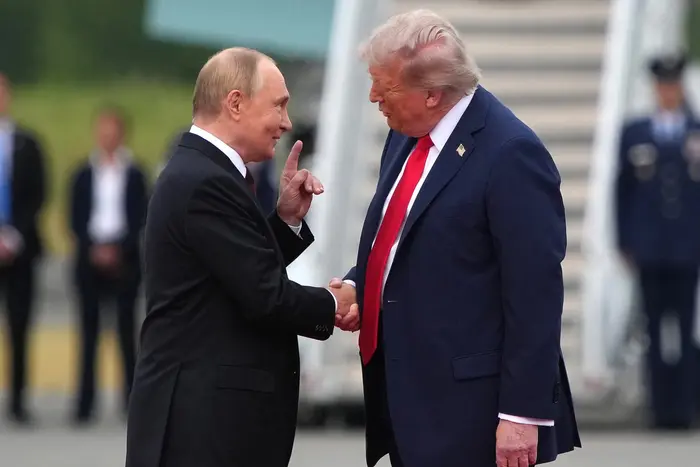
The policy of «personal diplomacy» that Donald Trump has been demonstrating towards Russian dictator Putin for more than a year has reached a strategic impasse
In early 2026, American foreign policy found itself at a crossroads. After a series of high-profile initiatives, including the Alaska summit in August 2025 and the creation of the «Peace Council» in Davos, the administration of President Donald Trump was faced with a harsh reality: Putin is not looking for compromise, he is looking for the capitulation of Ukraine and the West. Therefore, it is quite possible to argue that the continuation of the current strategy of «appeasement» carries critical risks for national interests and for the United States itself.
As of January 2026, the peace agreement on Ukraine was 90 percent ready. However, the Kremlin began to openly sabotage this process. The staging of a «drone attack» on Putin’s residence at the end of 2025 became an occasion for Moscow to take a tougher stance, which has already forced Trump to publicly call Putin «the main obstacle to peace». Supporting such an unpredictable partner undermines Trump’s reputation as a «deal maker». Russia insists on the so-called «Anchorage formula», which involves the complete transfer of Donbass under the control of the Russian Federation and the unfreezing of Russian assets.
Which is not only a geopolitical but also an economic trap for the United States. And here we can say that this is dangerous for Donald Trump for two reasons. The first reason is that by doing so, America is actually agreeing to finance Russian aggression. After all, if such a decision were really made, the unfrozen funds of Moscow would not be used to restore Ukraine, but to integrate the occupied Ukrainian territories into the system of the Russian Federation and strengthen its terrorist army. The second reason is Russia’s weakness.
As the Russian Federation enters 2026 with the weakest economy since the beginning of the war. Oil and gas revenues have fallen by a quarter, and the IMF has lowered its growth forecast to 0.8 percent. Therefore, Trump, as a businessman in the past, must understand that supporting a collapsing regime is not only investing in a hopeless asset, but also risking his reputation as an «effective manager».
Because in Donald Trump’s business logic, the ability to recognize a losing deal at an early stage and exit it in time is a sign of strength, not weakness. At the same time, it is necessary to take into account the geopolitical overvoltage, which the initiatives regarding the Gaza Strip and the «Peace Council» will in no way be able to compensate for. Trump is trying to involve Putin in resolving global conflicts, in particular by inviting him to the «Peace Council» regarding Gaza.
However, the presence of the Russian Federation in such structures only legitimizes the aggressor, without producing real results in the Middle East. In addition, it creates a «security vacuum» in Europe, where the United States’ NATO allies are already expressing concern about the reduction in the American presence.
It can be said that America’s refusal to support Moscow is a strategic gain. Since such a decision will lead to the restoration of trust in Washington by its allies in Europe. The US’s tough line towards the Kremlin will reassure Europe and force it to invest more actively in its own defense, which is a long-standing demand of Trump.
At the same time, a lever of pressure on China appears. Because the weakening of the Trump-Putin connection will deprive Xi Jinping of confidence in forming an anti-Western bloc.
There is also the possibility of real peace through force. As all recent world history shows, Putin reckons only with force. The refusal of the White House’s pressure on Ukraine, in an attempt to obtain concessions from it on territorial issues, will force the Kremlin to return to real negotiations without ultimatums.
It is time for the Trump administration to realize that Putin is using Washington’s «peacemaking» only to regroup forces. Refusing to support the Kremlin in 2026 is not just a question of morality for the Trump administration, but also a necessity to preserve the global leadership of the United States and avoid a humiliating defeat in the Ukrainian issue.
After all, it is quite clear that the policy of «personal diplomacy», which Donald Trump has been demonstrating for over a year towards the Russian dictator Putin, has reached a strategic dead end. Trump’s policy is often based on the belief that personal agreements with dictators can resolve systemic conflicts. However, in the context of Russia, this strategy has already completely exhausted itself.
Peace plans have completely failed. Hopes for a quick end to the war in Ukraine through direct negotiations with Putin have not been justified. The Russian dictator views any concessions not as a step towards peace, but as a sign of the West’s weakness, continuing aggression for the sake of complete control over the Black Sea region and Ukraine.
Geopolitical competition should not be ignored either. Because Putin and Trump are currently competing for the right to be the «chief destroyer» of international norms. If Donald Trump continues to support or even ignore Moscow’s actions, he risks personally handing the initiative to the Kremlin in key regions – from the Arctic to Venezuela.
It is also wrong for Washington to maintain American influence in the Arctic. The issue of the status of Greenland and control over the Northern Sea Route create an area of hard strategic collision between Washington and Moscow. It is natural that any concessions here to Putin weaken Washington’s defensive position in its own north.
At the same time, it is important to avoid the «China trap». There is no doubt that the strategy of using the «Peace Council», which is promoted by Trump, can be effective only when Russia is forced to balance between the USA and China. Putin’s support for the PRC makes Moscow a dependent junior partner of Beijing, which only strengthens the main strategic rival of the United States.
Economic pressure cannot be discounted as an effective tool to reduce Putin’s geopolitical ambitions. The Trump administration has already demonstrated its willingness to use tough measures, such as blocking tankers from Russia’s «shadow fleet». Increasing this pressure instead of «gingerbread» in the form of lifting sanctions is the only way to force the Kremlin to make real concessions.
Donald Trump is also forced to think about his reputation within the United States. The defeat of Ukraine or concessions to Putin will be perceived by the American establishment as a personal failure for Trump, which is unacceptable for the image of a «winner» he has cultivated.
And again, refusing to make deals «over the heads» of Europeans will help restore trust within NATO and transatlantic unity. This is critically important, as European allies have already begun to look for alternative security options, which could lead to the collapse of the Western collective defense system.
It is necessary to move to a policy of a new level of deterrence. Relatively speaking, the policy of the «big stick» in relations with Moscow – coercion to de-escalate through military superiority, will force other totalitarian states to reconsider their aggressive policies towards neighboring peoples and countries.
Thus, for Donald Trump, Putin has already ceased to be a potential ally in the cause of world reconstruction and has become an obstacle on the way to a «Greater America». Only through a strict distancing from the Russian dictator and a demonstration of strength to Moscow will Washington be able to dictate the terms of a new world order, where American interests will dominate the ambitions of regional dictators.
Читайте також:










Коментарі — 0