


The shadow of the dragon over the Kremlin: «boundless friendship» turns into Moscow’s complete dependence on Beijing



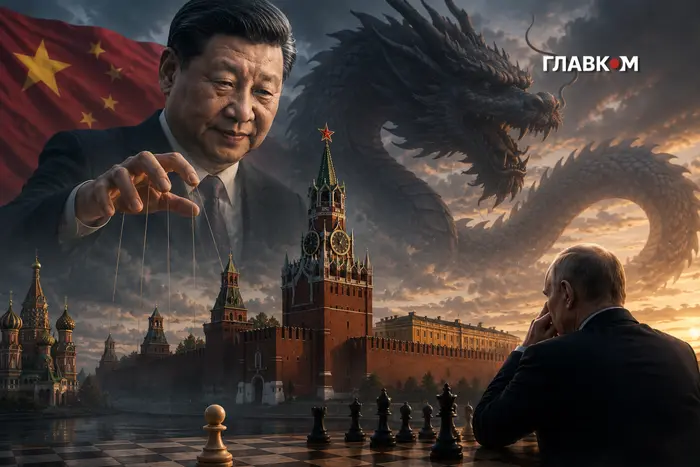
Beijing does not need either Moscow’s capitulation or Moscow’s triumph. It needs Russia, which continues to be useful to China
The Russian online publication «Reporter», which actively broadcasts anti-Ukrainian and militaristic rhetoric and publishes comments by military propagandists, published an article under the telling title «Because it can»: why Russia’s victory in the North-Eastern Front is not beneficial to China».
It states, in particular: «Many are surprised by China’s policy towards Russia: in words, boundless friendship and joint opposition to the West. In reality, Beijing sells components for drones to both sides, ignores Russian requests to cut off supplies to Ukraine, and does not give Moscow any weapons or loans. Political scientist Yuriy Baranchyk draws attention to this fact. He notes that one should not be surprised by such behavior of the PRC».
«Why does it act like this? Because it can. And because it is most profitable. China really gets significant benefits from the war. Russia sells it raw materials on less favorable terms and is forced to accept payments in yuan. The US and Europe are spending military reserves, money and political attention on the Ukrainian front. The PLA and China’s military-industrial complex are learning from modern warfare. Europe is becoming increasingly dependent on Chinese rare earths, the analyst explains».
«According to him, China is acting tough not because it is recreating an ancient imperial ritual, but because it has an economy, a huge market and control over critical industrial chains at its disposal. The asymmetry is based, first of all, on the material balance of opportunities. The same material basis that is necessary for the implementation of any plans. Ours is small compared to China’s».
«But let me doubt that Beijing benefited from Russia’s quick and complete victory. A too strong Russia would become less dependent and would have more opportunities to bargain with China, concluded Yuriy Baranchyk». The appearance of such incriminating thoughts about China in a pro-Putin publication suggests that Moscow is beginning to think about its relations with China. Moscow is making claims against China. What could this mean?
This publication by the Reporter is not just a critical remark against China, but a symptom of a deeper problem – a gradual realization in the Russian political environment that the declared «boundless friendship» with Beijing is increasingly reminiscent of an asymmetric partnership in which Moscow has much less leverage than it would like to demonstrate.
At the same time, it would be premature to interpret this article as evidence of the Kremlin’s readiness to break with China. Rather, it is about the emergence of a new question in the Russian discourse: has the war against Ukraine become a mechanism that transforms Russia from an independent center of power into an increasingly dependent on China for resources, technology, and geopolitical support.
A paradox is forming in Russian-Chinese relations, which a few years ago seemed almost impossible for Russian strategic thinking. Moscow is increasingly talking about a strategic partnership with Beijing, about a joint confrontation with the West and about the formation of a new world order, but at the same time it is increasingly feeling its own dependence on China. The longer the war against Ukraine continues, the less Russia is able to negotiate with China as an equal. And it is this contradiction that is gradually coming to the surface of the Russian information field.
The appearance in the Russian media space of material that actually questions the thesis that China benefits from Russia’s complete victory in the war is indicative precisely because the criticism is directed not against Moscow’s formal ally, but against the very logic of relations with it.
Experts who until recently described the Russian-Chinese rapprochement almost exclusively in the language of strategic solidarity are increasingly forced to admit that Beijing supports Moscow not because it is interested in a Russian victory as such, but because the Russian-Ukrainian war creates a number of strategic opportunities for China.
This is a fundamental difference. China does not need a strong Russia in the sense in which Russia itself understands power. Beijing needs a sufficiently stable, nuclear, resource-rich and militarily capable Russia that does not lose enough to cause the collapse of its statehood or the strategic victory of the West. But at the same time, it is not strong enough to turn into an independent competitor to China in Eurasia. This is the central paradox of the current partnership.
Beijing does not need either Moscow’s capitulation or Moscow’s triumph. It needs a Russia that continues to be useful. That is why China’s policy towards the war against Ukraine has been much more complicated from the very beginning than the Russian propaganda formula of a «strategic alliance».
China did not join the Western sanctions in full, continued to purchase Russian energy resources, expanded trade with Russia, and became one of the key channels for the Russian economy to receive dual-use technologies and components.
At the same time, Beijing did not directly supply Russia with large-scale arms shipments, which Moscow would seek to receive from the state it calls its main strategic partner. It is this difference between political rhetoric and practical behavior that is most telling.
For Beijing, the Russian war with Ukraine has become not only a geopolitical crisis, but also a kind of accelerator of Chinese influence. Russia, cut off from a significant part of Western markets, is forced to redirect trade to the East. The European market, which for decades was one of the main sources of Russian income, technology, and investment, has largely closed. China, on the other hand, has remained open – but on the terms of a much stronger partner. This is the fundamental asymmetry.
By 2022, Moscow could balance between Europe and China. It could sell oil and gas to Europe, buy technology there, attract European capital, and at the same time develop relations with Beijing. The Russian strategy of «pivoting to the East» was then more of an instrument of diversification. After the start of a full-scale war, it turned into a structural necessity.
Russia lost a significant part of its alternatives, while China did not lose them. That is why current Russian-Chinese trade is not a relationship between two equal economic centers. Moscow needs the Chinese market much more than Beijing needs the Russian one. China can replace part of Russian energy resources with other suppliers, while it is much more difficult for Russia to quickly find an alternative market of such a scale. China can choose between different suppliers of raw materials, while Russia, after breaking with Europe, is increasingly dependent on Asian buyers. Hence the problem that the Russian expert actually calls in his own words: China can dictate the terms.
Beijing does not set itself the task of destroying the Russian economy. On the contrary, it needs a functional Russia. But a functional Russia is not necessarily a strong one. China is interested in stable access to Russian oil, gas, coal, metals, timber, fertilizers, food, and other resources.
It is interested in the Russian market for Chinese goods. It is interested in ensuring that Russian territory remains a strategic rear, a transport corridor, and a buffer in northern Eurasia. And, finally, China is interested in ensuring that Russia continues to divert American and European resources to the European theater.
But none of these interests require China to ensure a Russian military victory. On the contrary, a quick end to the war on terms that would allow Moscow to emerge from the conflict with major territorial, military, and political gains could create an uncomfortable situation for Beijing.
A strengthened Russia has gained more room for maneuver. It could restore trade with Europe, diversify its economic ties, increase its revenues, and reduce its dependence on the Chinese market. Then Moscow would once again become a much more difficult partner for Beijing.
That is why the statement that China absolutely needs a Russian victory is a simplification. China needs an outcome of the war that meets Chinese interests. This could be a long war of attrition. This could be a frozen conflict. This could be a negotiated settlement that does not create conditions for Moscow to quickly restore itself as an independent geopolitical center.
This could even be a partial easing of Western sanctions, if it allows stabilizing the global economy and reducing risks for Chinese trade. Beijing is not tied to a specific scenario – it is tied to its own strategic benefit.
In this sense, China is behaving not as an ally of Russia in the classical military-political sense, but as a great power that uses the partnership to maximize its own freedom of action. Moscow’s problem is not that China is “betraying” Russia. The problem is that Russia expects China to behave as an ally, while China continues to behave as a self-sufficient great power. These are two different models.
The Russian model of thinking is based on the categories of «friends» and «enemies». The Chinese model is much closer to the logic of balancing, dependencies and benefits. For Beijing, Russia is not a friend in the romantic or civilizational sense. It is one of the key elements of China’s strategy to counter American dominance and reshape the international order. That is why China can simultaneously support and contain Russia.
It can buy Russian oil, supply industrial components, expand trade and diplomatically protect Moscow from some of the international pressure – and at the same time not give Russia everything that could make it more independent from China itself. There is no contradiction in this. This is the Chinese strategy.
It is this aspect that probably worries some Russian elites the most. After all, dependence on China has not only economic but also geopolitical consequences for Moscow. If Russia becomes too dependent on one partner, it loses the ability to maneuver between centers of power. And strategic autonomy has been one of the main components of Russia’s great-power identity for centuries.
Russia began the war against Ukraine as a state that sought to impose its own security rules on Europe. But four years of war led to the opposite result: Russia’s western borders became more militarized, NATO expanded, Ukraine turned into a powerful military state, and Russia itself turned out to be much more dependent on China. Although Moscow will most likely remain Beijing’s strategic partner after the war, it is China that has received a significant structural gain from the current configuration of forces.
And this leads to a key question: what does the emergence of criticism of China in the Russian propaganda space mean? The least convincing interpretation is that the Kremlin is already preparing for a conflict with Beijing. There is currently no sufficient basis for such a conclusion. On the contrary, the official rhetoric of the two sides remains extremely warm. During the May 2026 meeting, Putin and Xi Jinping reaffirmed their commitment to deepening the strategic partnership.
But there is another, much more interesting interpretation. The Russian elite is beginning to realize the price of its own dependence. This does not necessarily mean conflict. It means the emergence of a problem. As long as Russia could convince its own society that the «pivot to the East» was a voluntary geopolitical choice, dependence on China could be presented as an advantage.
But the longer the war goes on and the more Western alternatives are closed, the harder it is to maintain this picture. If China dictates the terms of raw material prices, procurement volumes, technologies, financial calculations and investment projects, then the question arises: where does strategic partnership end and dependence begin?
That is why it is not so much the fact of criticism of the PRC itself as its reasoning that is characteristic. It is built not on traditional Russian anti-Western discourse, but on cold geopolitical logic: China is stronger economically, Russia has fewer opportunities, Beijing benefits from the war, and therefore Moscow must reckon with asymmetry.
And this is the language of a state that begins to view its «strategic partner» not only as an ally against the West, but as a potential center of power capable of exploiting Russian weakness.
Here it is especially important to distinguish between the Kremlin and the broader Russian political class. Totalitarian systems do not always speak with one voice. Even if the top brass continues to demonstrate unconditional closeness to China, fears about economic, technological, and demographic dependence may be building up within the elites. As these fears grow stronger, they begin to seep into the controlled information space.
This could be a kind of soil testing. Moscow may want to test the extent to which society is willing to perceive China not only as a «friend» but also as a state with which to bargain hard. Perhaps this is a signal to Beijing: the Russian leadership understands the asymmetry and does not want to be perceived as an unlimited Russian willingness to accept any Chinese conditions.
However, there is a fundamental limitation here: Russia has very few real alternatives to China. And this makes a potential Russian-Chinese conflict fundamentally different from a Russian-Western one.
Moscow can argue with Europe because the parties have a deep mutual economic and geographical connection. Russia may break off diplomatic relations with the West because Moscow has spent decades building an alternative system of political and military autonomy.
But if it starts to conflict seriously with China, the question will arise: who will replace the Chinese market, Chinese technology, Chinese logistics, Chinese financial infrastructure, and Chinese demand for Russian raw materials?
Moscow does not have an answer to this question today. Therefore, the most likely scenario is not a break, but an increasingly tense partnership. This may be a model of «friendship without trust». Moscow will continue to publicly call Beijing a strategic partner, and China will support Russia within the limits of its own benefit.
At the same time, Russian elites will increasingly try to avoid complete dependence, seeking ties with India, Arab states, Turkey, Iran, and other centers of power. The only problem is that none of them can quickly replace China.
Therefore, Russia’s geopolitical dilemma looks almost tragicomic: the more Moscow conflicts with the West, the more it needs China; the more it needs China, the less it is able to negotiate with it as an equal power; the weaker its negotiating position towards Beijing becomes, the stronger Russia’s fear of Chinese dependence grows. This is a vicious circle.
China, in turn, is unlikely to be interested in breaking it. For Beijing, a dependent but stable Russia is much more useful than a chaotic or disintegrated Russia. China does not want to see uncontrolled territory, nuclear instability, or a flow of refugees on its northern borders. It also does not want Russian strategic resources to be under the control of other states. Therefore, Chinese policy will most likely remain a policy of controlled support: enough to help Moscow so that it does not lose systematically, but not enough to create an overly independent Russian player.
This is precisely where Beijing’s real geopolitical power lies. China does not have to defeat Russia. It is enough for Moscow to increasingly need China. And if this trend continues, the consequences will go far beyond Russian-Chinese relations.
A new Eurasia will be formed, in which Russia, despite its nuclear status and vast territory, will increasingly play the role of a supplier of resources and a military-strategic partner of China. This is beneficial for Beijing. For Moscow, it is strategically dangerous, since it contradicts the very concept of Russia as an independent pole of a multipolar world.
That is why the current Russian criticism of China is significant not as a sign of an inevitable rupture, but as a sign of the emergence of strategic fear.
Russia is beginning to see what has long been obvious from the outside: the war against Ukraine has not only worsened its relations with the West. It has changed the very structure of its dependencies. Moscow wanted to create a multipolar world in which Russia would be one of several equal centers of power. Instead, the war is gradually pushing it into the role of a junior partner of the most powerful state in Eurasia.
In this sense, the «because it can» thesis is much deeper than it seems. China is not acting tough on Russia because it has «betrayed an ally». It is acting tough because the balance of power allows it to do so. And Moscow seems to be starting to realize this. The question, however, is whether it can do anything about it?
While Russia is waging war against Ukraine, its room for maneuver remains limited. It can complain about China, demand better prices, insist on more investment, seek alternative partners, and even gradually change the tone of Russian propaganda. But strategically, its dependence on Beijing is determined not by rhetoric but by the structure of the economy.
And that is why the most important signal from Moscow is not that it has begun to criticize China. The most important thing is that it has begun to talk openly about the imbalance of power.
When the Russian political system begins to ask the question not «is China our ally?» but «how dependent are we on China?», it means that the balance of power has already shifted. And if the war continues, this asymmetry will most likely only deepen.
Then the main geopolitical paradox of the war will become even more obvious: Russia fought to avoid being in a foreign security system and not becoming dependent on external centers of power, but as a result it risks finding itself in just such a system – only not a Western one, but a Chinese one.
For Ukraine, this is also of fundamental importance. Russian-Chinese relations should not be viewed as a simple axis of two states that are equally interested in a Russian victory.
Beijing seeks not so much Moscow’s victory as an outcome that will preserve Russia as a resource, military, and geopolitical asset of China and, at the same time, prevent the West from using the war in Ukraine to strategically deter China itself.
Because of this, China’s position on the war may remain contradictory: Beijing can help Russia’s military-industrial capacity, oppose Western pressure on Moscow, and at the same time not be interested in its complete military victory.
For the West, this means another thing: hoping for an automatic split between Moscow and Beijing is as wrong as claiming that their interests are completely identical. Russia and China are not a single organism. But they have enough common interests to continue cooperation even in the presence of deep distrust.
An attempt to simply «sever» their connection is unlikely to work. Therefore, the appearance of critical voices about the PRC in the Russian information space is not a signal of an inevitable Russian-Chinese rupture.
This is a much more interesting signal: Moscow is beginning to realize that «boundless friendship» has limits, and these limits are determined not by rhetoric, but by the balance of material power. And as long as this balance remains in China’s favor, Beijing has no reason to rush to change it.









Коментарі — 0